Overview
This MSc thesis investigates the effectiveness of four GAN architectures for synthesizing realistic EEG data, addressing the critical challenge of data scarcity in neurophysiological research. The study compares Standard GAN, DCGAN, DualGAN, and WGAN-GP on their ability to generate synthetic EEG signals for two distinct mental states: Concentrating and Relaxed.
The Problem
High-quality labeled EEG data is expensive and difficult to acquire. This scarcity limits model performance and generalization. Traditional augmentation methods fail to capture EEG's intricate temporal and spatial dependencies — GANs offer a more sophisticated alternative, capable of learning the underlying signal distribution to generate high-fidelity synthetic samples.
Approach
- Dataset: Public EEG dataset (Bird et al., 2018) — "Concentrating" and "Relaxed" mental states, preprocessed with normalization, temporal alignment, and 5-channel selection (TP9, AF7, AF8, TP10, Right AUX).
- GAN Architectures: Standard GAN (baseline) · DCGAN (convolutional features) · DualGAN (paired generator-discriminator per class) · WGAN-GP (training stability, anti-mode-collapse).
- Evaluation: Pearson Correlation · KL Divergence · Spectral Similarity · PSNR · Fréchet Inception Distance (FID).
Key Technologies: Python · PyTorch · GANs · EEG Signal Processing · SciPy
Results
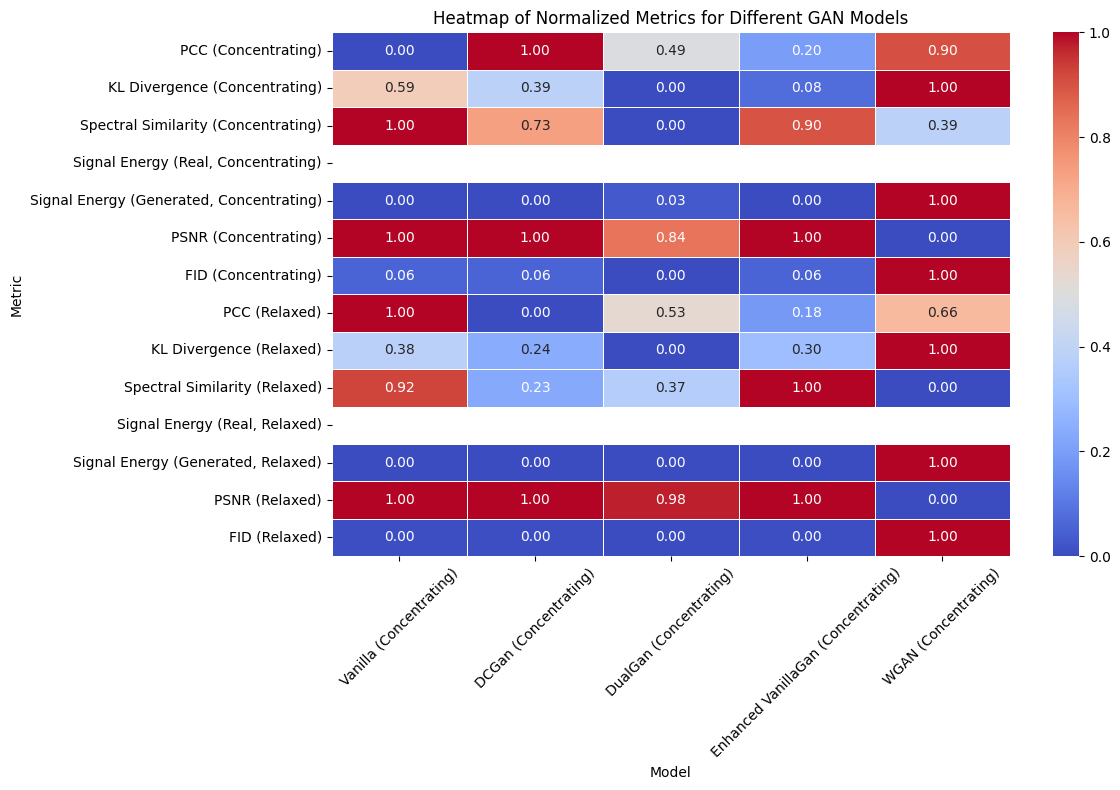
Heatmap: similarity between generated and real EEG signals across channels and conditions.
- WGAN-GP — Top Performer: Highest combined performance score (0.6623), superior stability, highest-fidelity signal generation.
- DualGAN — Statistical Alignment: Best performance on KL Divergence and FID metrics.
- Validated GANs as Augmentation Tool: Advanced architectures can generate high-quality synthetic EEG that expands training datasets meaningfully.